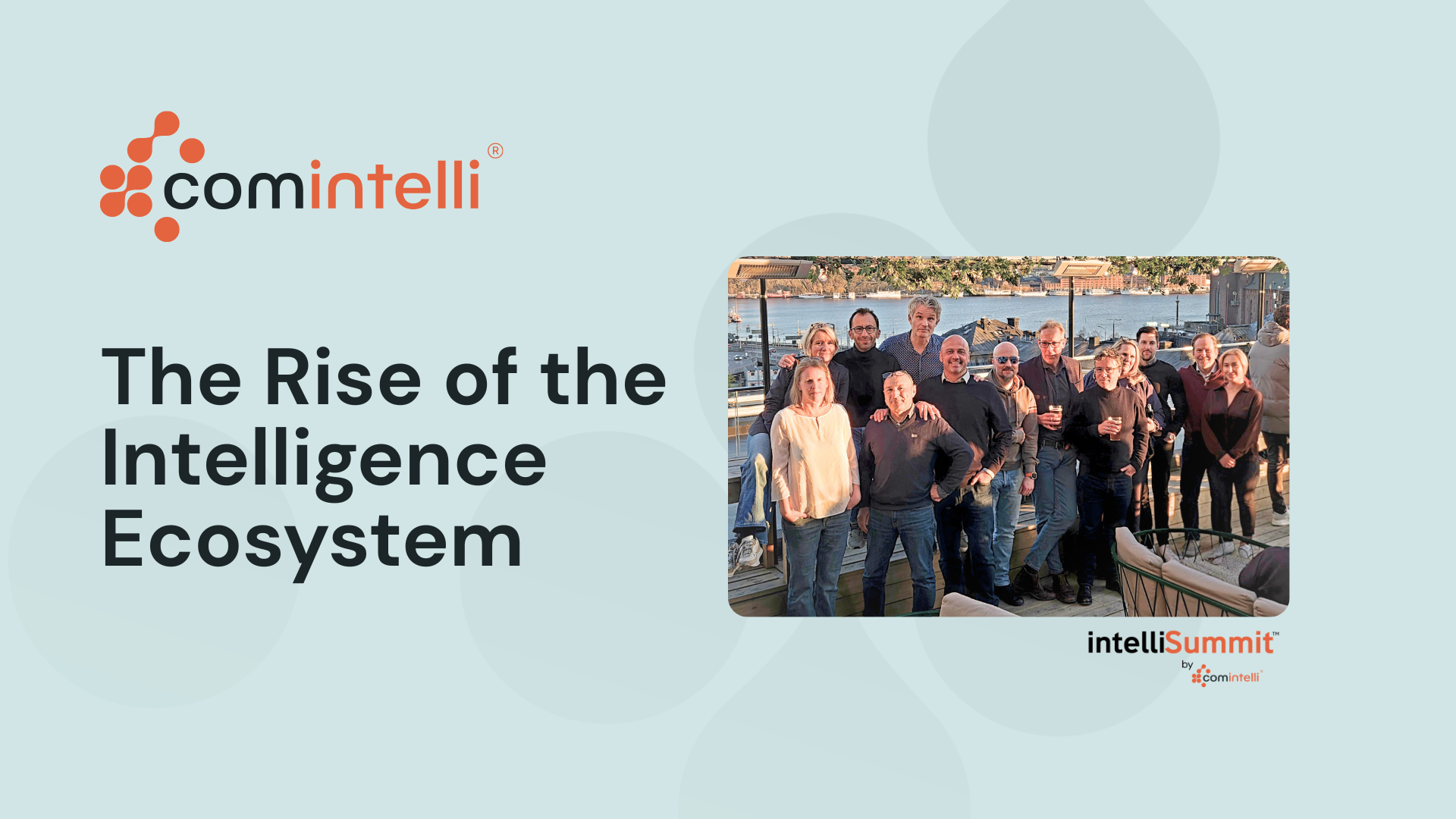
In our 3 part webinar series, we shared insight into technology and CI – how they go hand-in-hand, as well as what some of the myths, mistakes and lessons learned are around choosing a CI platform.
Today, there are quite a few tools in the market that are being promoted as Competitive Intelligence tools or systems – but what should you be able to expect from a real CI system?
In this webinar, this is discussed along with SharePoint and how AI can assist you with your Competitive Intelligence process. Below is a summary of all three webinars which you can also watch in your own time, here.
What are some modern CI myths? Mistakes and lessons learned.
Buying a CI software platform is a big decision, and one does not want to be purchasing a new one every year. Like any critical purchase, you have to figure out what the company’s needs are and what you hope to achieve with Market and Competitive Intelligence.
If you’re doing your research into finding the best Competitive Intelligence software to suit your company’s needs, there might be a few mistakes you are encountering. With confusing terminology and CI jargon, it’s no wonder many make the mistake of choosing the wrong CI tools.
Let’s do some myth-busting.
Myth 1 – If it’s called a CI system, it must be a CI system
Have you ever been pitched a CI system that wasn’t actually a CI system? You’re not the first. In fact, there are many tools in the market that claim to be real CI software tools, when in fact, they only serve one niche aspect of Competitive Intelligence and not the complete picture.
Defining a CI system
In order to understand which market and Competitive Intelligence system to choose, one should understand the true definition of CI software.
A Competitive Intelligence system is a digital platform that automates CI work to:
- Collect and classify/tag internet and external information about the market and business environment.
- Allow users not only to be notified of news but also search and curate content.
- Provide analytical features that enable users to discover new insights.
- Make use of dashboards, alerts, templates, reports and collaboration features to share actionable intelligence across organizations.
A complete CI system will cover all four of the following areas:
- Media Monitoring
- Intelligence management
- Trend radar
- Insight generation
If a system does not cover the above, it is considered to be a niche system. What’s an easy way to tell the difference? Complete CI systems will integrate with supporting systems and a niche CI system will work with separate systems and have lower integration capabilities.
Myth 2 – AI will make all our dreams come true
This is of course, not true. Although AI has helped automate countless tasks and speed up processes, the work still needs to be done. This is where intelligence officers and business intelligence managers shine.
AI’s greatest benefits are in two areas:
Analytic support
- Trend identification
- Visualization
- 360 scanning
Retrieving, monitoring and managing
- Classification
- Summarization
- Translation
- Sentiment Analysis
AI is great to provide the heavy lifting for some very time-consuming tasks. But it is also a helping hand in identifying potential areas of interest. It can point you in a direction, but it’s still you, the analyst, that needs to take it forward. AI will help you do more with less, but you still need to do the thinking.
Myth 3, 4 and 5: Understanding ROI with Competitive Intelligence
Can ROI be measured with Competitive Intelligence platforms? How do you measure the true value of a CI platform? We’ve heard the following many times:
Myth 3: “You can’t measure the value of CI!”
Myth 4: “You don’t need a CI platform to do CI!”
Myth 5: “CI platforms always wither & die!”
Starting with myth 3, you definitely can measure the value of your Competitive Intelligence system. In fact, there are many ways to measure and it is extremely important that you do measure.
How to measure the value of a CI platform:
- Think about what needs to be measured and for what purpose.
- Look at different ways of defining “ROI” as traditionally it has been defined as “to count”.
- With CI, we are trying to measure intangible aspects such as reputation and trust of intelligence output, this means getting specific in your measurements and finding new ways to measure.
- Think about Subjective vs Objective and Qualitative vs Quantitative instead of the system as a whole.
Here are a few different ways to measure quantitative and qualitative.
Hard metrics (quantitative)
System Usage statistics
- No. of total users
- No. of active users (logged in users per week/month)
- No. of daily email alerts
- No. of search queries
Output, deliverables
- No. of requests (demand)
- Response time
- Estimate time spent on research versus analysis
- No. of reports produced
- Cost savings by centralizing information
Soft metrics (qualitative)
- User Satisfaction Surveys
- Interviews with core users
- Quality and freshness of intelligence
- Knowledge sharing culture
- Cases and deals won where CI has been involved
- Level of involvement in decision-making processes
- Strategic awareness in the organization
The next myth to be busted is myth 4: “You don’t need a CI platform to do CI”
This is technically true, but…do you want to be the person that does the Grunt Work or the Great Work? Having a CI platform can alleviate your data and intelligence in a way that no human can. For example:
Great work:
Analytical support such as:
- Trend Identification
- Visualization
- 360 Scanning
Grunt work:
Automatically retrieving, monitoring and managing such as:
- Classification
- Summarization
- Translation
- Sentiment
Here are 7 reasons why should you should spend money on a CI platform
- Time savings – Let the machines handle the volume.
- Focus CI work on analysis!
- Cost savings – coordinated purchasing of information sources.
- Do more with fewer resources!
- Improve your ability to differentiate yourself from competitors
- Help you win deals!
- Clearer marketing messages
- Know your customers better!
- Trustability by using quality sources.
- The web is unreliable!
- A small team can spread insights to many decision-makers
- Making CI more actionable!
- More exposure to CI means that CI gains a more solid position.
- Best branding of CI!
And lastly, myth number 4: “CI platforms always wither and die!”
M&CI platforms are often enthusiastically implemented as a reaction to management needs.
Companies start collecting lots of content from all sorts of places. But without a clear purpose or target, they often end up contributing to information overload with too much outdated, irrelevant information. For this reason, it’s important to put measures in place that will sustain the longevity and effectiveness of your CI platform:
Use Key Performance Indicators (KPIs)
KPIs are a more forward-looking predictor of CI system performance than ROI.
By defining and monitoring the right KPIs, you can gain valuable insight into your business and make the adjustments needed to optimize your performance.
The challenge is knowing which KPIs are most important to monitor to get the results you want.
- Define the metrics that matter to you, both hard and soft.
- Make sure to measure them consistently over time! Publish the results widely.
- Don’t just use them to justify the investment, but also use them to improve your CI tools and systems.
Conclusion
No company is the same and for that reason, not all metrics fit into a standardized box. This is why it’s important to spend time early on to determine your goals and metrics. Throughout using CI, you should continually evaluate, review and analyze your KPI’s as they may change and evolve over time.
The simple truth is that CI platforms that fail are simply not good enough in today’s ultra-competitive environment. If they don’t deliver actionable insights to decision-makers, they have low value. But it’s up to managers and intelligence managers to ensure the work is done effectively to see the real results CI can bring.
Download the full webinar recordings to watch in your own time, and receive a summarised PDF of everything you need to know.